
Can You Clean The Driveshaft On Your Car?
Dec 4, 2025
At Driveshaft UK, we’re often asked whether certain vehicle components can be cleaned rather than replaced. One part that raises this question regularly is the driveshaft. It’s a vital part of your car’s drivetrain, responsible for transferring power from the engine and gearbox to the wheels. It works hard under the car, taking on rotation, torque, and suspension travel every time you drive. But because of its location underneath the vehicle and exposure to the elements, it’s also prone to getting dirty, rusty, or covered in road grime.
Many drivers, particularly those with vehicles that see regular long-distance travel or heavy loads like campervans, ask about the care of VW T4 driveshafts. These are commonly subject to wear, corrosion, and grease build-up, especially in older models. Cleaning seems like an attractive option to prolong their life or maintain performance, but the truth is a bit more nuanced. This article explores whether you can—and should—clean the driveshaft on your car, how to do it safely if appropriate, and when it’s time to consider repair or replacement.
What Does the Driveshaft Actually Do?
Understanding what the driveshaft does helps put the cleaning question into context. The driveshaft is a rotating tube that transfers torque from your vehicle’s transmission to the differential, which then sends power to the wheels. In front-wheel-drive vehicles, the equivalent component is often called a half-shaft or CV shaft. Rear-wheel and four-wheel drive vehicles use longer propeller shafts that run the length of the car.
This part of the drivetrain works constantly while the vehicle is moving. It rotates at high speed, flexes slightly to follow the suspension’s movement, and must be perfectly balanced to avoid vibrations. As such, the driveshaft isn’t just a rod or pipe you can wipe clean like a trim panel—it’s a precision component. Some types, including those found in many VW T4 models, also contain universal joints (U-joints) or constant velocity (CV) joints, which require lubrication and have protective rubber boots to keep out debris.
Should You Clean a Driveshaft?
In certain cases, yes, the driveshaft can and should be cleaned. If you’ve been driving off-road, through mud, snow, or salt-covered roads in winter, your underbody and driveshaft can become caked with debris and corrosive materials. Leaving it in this condition can encourage rust and premature wear, especially on exposed metal or worn protective coatings.
Cleaning the driveshaft can help you inspect it more clearly. If you’re doing a visual check during routine maintenance or before a MOT, removing built-up dirt can help you spot damage, worn boots, or leaking grease. Cleaning is also worthwhile if you’re about to apply rust prevention coatings or paint to the underbody.
However, it’s important to remember that a driveshaft is not a cosmetic part. Excessive cleaning, particularly using high-pressure water or harsh chemicals, can damage seals or force moisture into areas that should remain dry and lubricated. If the driveshaft has CV joints or U-joints with rubber boots, blasting them with water could cause cracking or splitting. Always approach cleaning with care and use the appropriate method.
How to Safely Clean the Driveshaft Area
If you’re planning to clean the driveshaft, make sure the vehicle is securely raised and supported on axle stands. Never work under a vehicle supported only by a jack. Safety must come first. Once you have proper access, use a soft brush or cloth to remove loose dirt. For more stubborn grime, a degreaser safe for metal and rubber components can be used, followed by a gentle rinse with a hose—not a pressure washer.
Avoid applying water directly to CV joints or U-joints. Instead, clean around them carefully and check for any signs of leaking grease, cracked boots, or worn clamps. If you see any damage, it’s a sign that further repair work may be needed. Never attempt to clean the inside of a CV joint or lubricated component unless you’re replacing or rebuilding the part entirely. These areas are sealed and must remain uncontaminated to function correctly.
Cleaning should also be followed by proper drying. Leaving water or degreaser residue on the driveshaft can lead to surface rust or corrosion, particularly on older vehicles or those with already-worn coatings. If you’re adding an anti-rust spray or underseal, ensure the driveshaft is dry and free of grease before applying.
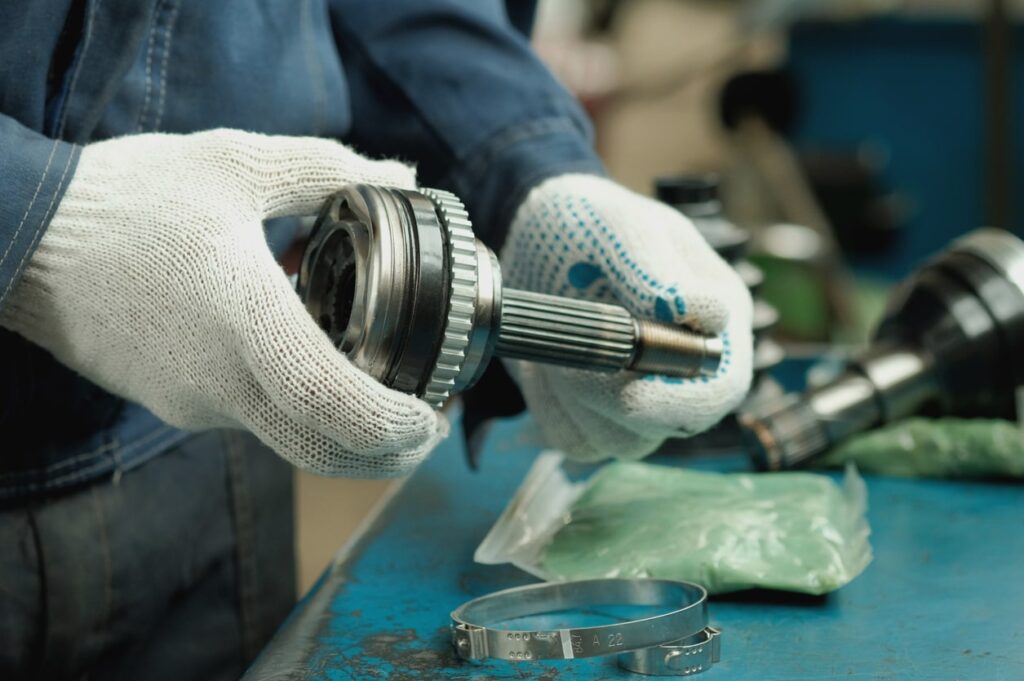
When Cleaning Isn’t Enough
There comes a point where cleaning the driveshaft just won’t resolve the issue. Rust on its own isn’t always a problem—many driveshafts develop surface corrosion over time and still function perfectly. However, deep rust pitting, play in the joints, vibration when driving, or knocking sounds when turning all point to mechanical wear that cleaning won’t fix.
In these cases, it’s better to replace the driveshaft rather than try to clean or repair it. At Driveshaft UK, we often see customers attempt temporary solutions like taping damaged boots or trying to grease worn joints, only for the part to fail shortly after. Replacing a failing driveshaft is not only safer but also more cost-effective in the long run. Ignoring the signs can lead to breakdowns or damage to surrounding parts like the differential, gearbox, or suspension.
This is especially true for vehicles like the VW T4, where driveshafts have seen decades of service. A worn or unbalanced driveshaft can make the van feel unstable at speed, produce vibration through the steering, and reduce fuel efficiency. Cleaning won’t resolve these underlying issues. If you’re unsure, we’re always happy to advise on whether a part can be salvaged or if replacement is the better route.
The Benefits of Driveshaft Maintenance
While cleaning can only do so much, it forms part of a broader approach to driveshaft care. Periodic inspection, even if you’re not mechanically minded, can help catch problems early. If you regularly check under your car, especially after winter driving or long journeys, you’re more likely to spot a torn CV boot, rusted flange, or loose bolts before they cause major problems.
Keeping the area around the driveshaft clean also helps mechanics carry out more accurate assessments. When a vehicle is covered in grime, it’s harder to tell where leaks are coming from or what’s causing a noise. A clean underbody allows for more effective diagnosis, which means quicker and cheaper repairs.
Additionally, maintaining your driveshaft and related components helps your car perform better. It improves handling, reduces drivetrain strain, and enhances fuel economy. Whether you drive a city hatchback, a long-wheelbase van like the VW T4, or a rear-wheel-drive saloon, a smooth and well-balanced driveshaft helps everything run more efficiently.
When to Consider Replacement
If you’ve cleaned the driveshaft and still notice performance issues—such as clunking during gear changes, vibrations under load, or a feeling of drag when turning—it’s probably time for replacement. Driveshafts are not immune to wear, and components like CV joints, splines, and bearings have a finite lifespan.
At Driveshaft UK, we supply a full range of replacement driveshafts for all makes and models, including VW T4 driveshafts, which remain among our most requested parts due to the popularity and age of the vehicle. Our parts meet or exceed original specifications, ensuring a perfect fit, excellent performance, and long-term reliability.
We also offer technical support, so if you’re unsure whether your driveshaft can be cleaned, repaired, or needs to be replaced entirely, our UK-based team is ready to help. We’ll ask the right questions, review any symptoms, and guide you toward the best option based on your budget and vehicle use.
Final Thoughts: Clean, Inspect, Replace When Necessary
Cleaning your car’s driveshaft isn’t a bad idea, especially if it’s covered in road salt, mud, or grease. It can help you inspect it more clearly, prevent corrosion, and spot small issues before they become serious. However, cleaning is not a substitute for proper maintenance or timely replacement when mechanical wear sets in.
At Driveshaft UK, we believe in giving drivers the tools and knowledge they need to make informed decisions about their vehicles. Whether you’re doing a basic clean and inspection or preparing to replace a worn driveshaft, we’re here to provide high-quality parts and expert support every step of the way.
If you’re unsure where to start, or if you think your driveshaft might need attention, give us a call. We’ve been helping UK drivers keep their cars, vans, and 4x4s running smoothly for years. From VW T4 driveshafts to the latest hybrid and electric models, Driveshaft UK is your trusted source for quality, guidance, and peace of mind.