
Understanding CV Joints and Drive Shafts in Your Vehicle
Oct 27, 2023
Is a Drive Shaft and CV Joint the Same Thing?
In the intricate world of automotive engineering, it’s crucial to distinguish between the components that contribute to your vehicle’s smooth operation. While the terms “drive shaft” and “CV joint” are often used interchangeably, they are not synonymous. A drive shaft serves as the conduit for transmitting power from the engine to the wheels, essentially the mechanical lifeline that propels your vehicle forward. On the other hand, a CV (Constant Velocity) joint represents a specific subset within the drive shaft, responsible for maintaining a consistent velocity while flexibly accommodating the up-and-down movements of your vehicle’s suspension. In essence, while they are closely related and function in tandem, the CV joint is just one integral part of the larger drive shaft assembly, with each component playing a unique role in ensuring a seamless driving experience.
What Happens If a CV Joint Fails?
The implications of a failing CV joint extend beyond mere inconvenience and can have profound consequences for your vehicle’s performance and safety. When a CV joint begins to deteriorate, it can manifest in a variety of telltale symptoms. One of the most common signs is a series of unsettling clicking or popping sounds emanating from your vehicle, particularly noticeable when executing turns. Additionally, you might experience vibrations during acceleration, a disconcerting sensation that can shake your confidence in your vehicle’s reliability.
However, the repercussions of a CV joint failure go beyond mere discomfort. As the joint’s condition worsens, it can lead to a loss of power being transmitted to the affected wheel. This loss of power can, in turn, result in reduced traction and a diminished ability to propel your vehicle forward. In extreme cases, a completely failed CV joint can leave your vehicle immobilised, leaving you stranded and requiring immediate assistance.
Moreover, the consequences of a deteriorating CV joint aren’t limited to its isolated impact. A malfunctioning CV joint can inflict collateral damage on other nearby components, potentially exacerbating the scope of repairs and increasing repair costs. This underscores the critical importance of addressing CV joint issues as soon as they become apparent to prevent further complications.
How Much Does It Cost to Replace a CV Shaft?
When it comes to the cost of replacing a CV shaft, it’s essential to consider a range of factors that contribute to the overall expense. The total cost can be influenced by variables such as the make and model of your vehicle, prevailing labour rates in your geographical area, and your choice between new or remanufactured CV shafts. On average, you can anticipate an expenditure ranging from £100 to £400 per CV shaft. It’s worth noting that if you’re replacing both CV shafts (front left and right), the total cost will naturally be higher.
The financial outlay also encompasses the labour costs associated with the installation of the new CV shafts, which can range from £150 to £400. To obtain a precise estimate tailored to your specific vehicle and location, it’s advisable to seek quotes from reputable mechanics or repair shops. While the cost of replacing a CV shaft is an investment in your vehicle’s functionality, safety, and longevity, obtaining multiple quotes can help you make an informed decision and ensure a competitive price.
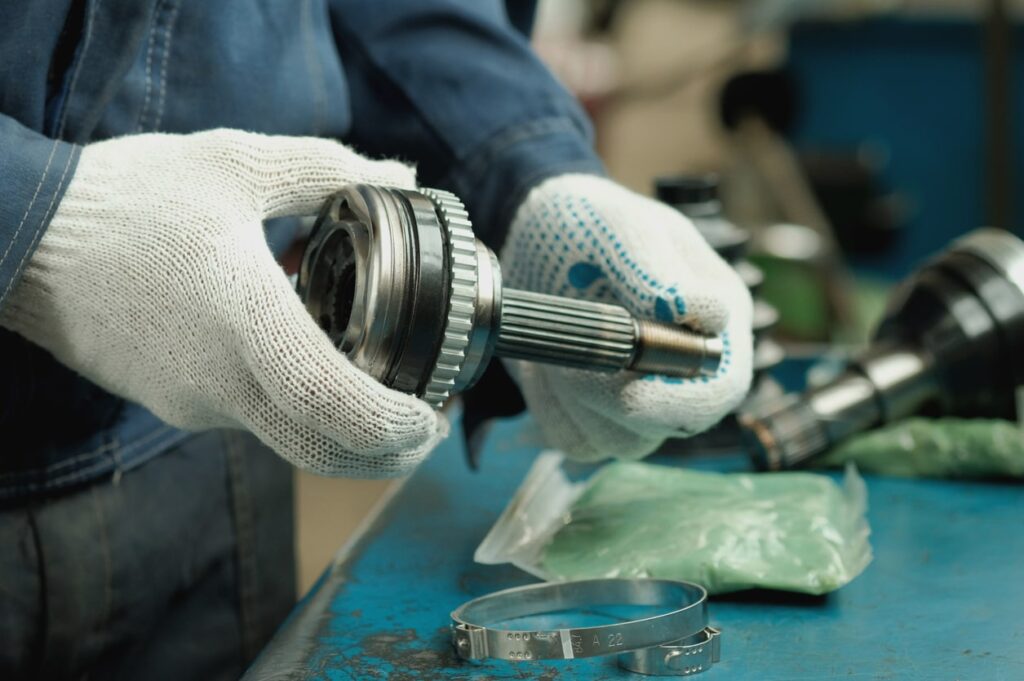

Can I Still Drive with a Bad CV Joint?
The prospect of driving with a malfunctioning CV joint is one that should be approached with great caution and reluctance. While it is theoretically possible to operate your vehicle for a short distance with a failing CV joint, it is categorically discouraged and not recommended by automotive experts and safety advocates.
When a CV joint is in a compromised state, it not only affects your vehicle’s performance but also poses significant safety risks. You may experience a sudden and alarming loss of power to the affected wheel, resulting in compromised control and stability. Erratic steering behaviour, vibrations, and compromised traction can make your vehicle challenging to manoeuvre safely.
Furthermore, driving with a failing CV joint increases the probability of a complete and catastrophic joint failure. Such an event can cause an abrupt loss of power to one or both wheels, rendering your vehicle inoperative and potentially stranding you in an unsafe location. Additionally, a severe CV joint failure can cause significant damage to surrounding components, amplifying repair costs and extending downtime.
DIY CV Joint Replacement – A Complex Undertaking
While the importance of addressing a failing CV joint promptly is undeniable, some automotive enthusiasts may consider a do-it-yourself (DIY) approach to save on repair costs. However, it’s essential to acknowledge that replacing a CV joint is a complex task that requires a high level of mechanical skill, specialised tools, and safety precautions. It involves disassembling critical components of your vehicle’s suspension and drivetrain, making it a challenging endeavour for inexperienced individuals.
Moreover, DIY CV joint replacement can present several risks. Mishandling or incorrectly installing a CV joint can lead to further damage or compromise safety. If you’re not well-versed in automotive repair, it’s generally recommended to entrust this task to a professional mechanic or technician who has the expertise and resources to perform the replacement correctly.
Do All Cars Have CV Joints?
CV joints, pivotal in the drivetrain system, are widely integrated into vehicles across various car brands available in the UK. European manufacturers such as Volkswagen, BMW, and Mercedes-Benz consistently incorporate CV joints in their models like the Volkswagen Golf, BMW 3 Series, and Mercedes C-Class to enhance performance and handling. Similarly, Japanese brands like Toyota, Honda, and Nissan often feature CV joints in popular models like the Toyota Corolla, Honda Civic, and Nissan Qashqai, ensuring smooth power delivery and driving dynamics.
American manufacturers like Ford, Chevrolet, and Dodge, known for their diverse lineup, frequently utilise CV joints in front-wheel-drive models like the Ford Focus, Chevrolet Cruze, and Dodge Charger, contributing to agility and performance. Korean brands such as Hyundai and Kia prioritise efficiency and reliability, integrating CV joints into models like the Hyundai i30 and Kia Sportage for responsive handling. Even other prevalent brands like Fiat, Peugeot, VW and Vauxhall commonly use CV joints in vehicles such as the Fiat 500, Peugeot 3008, VW Golf and Vauxhall Corsa, underscoring the widespread adoption of these components for optimal drivetrain functionality and performance across the automotive landscape in the UK.
Preventing CV Joint Issues – Regular Maintenance
Preventative maintenance is often the most effective strategy for avoiding CV joint problems altogether. Regularly inspecting your vehicle’s CV joints, boots, and related components can help identify issues before they escalate into major problems. Signs of CV joint wear, such as damaged boots or unusual noises during turns, should prompt immediate attention. Replacing worn-out CV joint boots promptly can prevent contaminants from entering the joint and extend its lifespan.
Additionally, maintaining a consistent schedule of wheel alignments and tire rotations can help distribute wear and tear evenly, reducing the strain on your CV joints. Properly inflated tires also play a role in minimising stress on the joints, so monitoring tire pressure is essential.
In essence, the overriding consensus among automotive experts is that driving with a bad CV joint is inadvisable and potentially perilous. It is essential to prioritise your safety, the safety of passengers, and the integrity of your vehicle. If you suspect a CV joint issue or have witnessed symptoms of CV joint failure, it is prudent to refrain from driving your vehicle and have it promptly inspected and repaired by a qualified mechanic. Prompt attention to this critical issue will not only enhance your safety but also prevent further damage to your vehicle, potentially saving you both time and money in the long run.