
What Causes Drive Shaft Failure?
Sep 14, 2025
At Driveshaft UK, we work with Audi, BMW, Mercedes, and many other makes on a daily basis, so we see first-hand what can happen when a driveshaft begins to fail. For many drivers, the driveshaft is not a component they think much about until problems arise, but it plays an essential role in keeping your car moving smoothly and reliably. If you have ever experienced unusual vibrations, clunking noises, or difficulty accelerating, your driveshaft could be at the root of the issue.
In this blog, we will explore what actually causes driveshaft failure, why it happens, and how you can prevent it. We will also cover the specific challenges faced by different vehicle types, including popular Audi models such as the A3, A4, and Q5, which often come into our workshop. By understanding the main causes of driveshaft failure, you can take the right steps to keep your vehicle safe, reliable, and on the road for longer.
The Role of the Driveshaft
Before diving into what causes failure, it is important to understand exactly what a driveshaft does. A driveshaft is a rotating tube designed to transfer power from your vehicle’s gearbox or differential to the wheels. It is critical in translating the engine’s power into motion, ensuring the car accelerates, corners, and performs as expected.
In Audi models like the A6 or Q7, which are often fitted with quattro all-wheel drive systems, driveshafts are even more important because they distribute power to multiple wheels at once. Without a properly functioning driveshaft, power delivery becomes uneven, vibrations increase, and eventually, the car can become unsafe to drive.
Wear and Tear Over Time
One of the most common reasons for driveshaft failure is simple wear and tear. Like any moving part, the driveshaft is subject to constant stress and strain. Over the years, the joints, bearings, and connecting points can wear down, particularly if the car is used frequently for long journeys or heavy loads.
For drivers of an Audi A4 or A5, for example, the driveshaft may begin to develop small signs of fatigue after thousands of miles. These signs might start as slight vibrations at higher speeds or faint noises when turning. Ignoring these early warnings can eventually lead to complete driveshaft failure.
In the UK, where road conditions vary from smooth motorways to bumpy rural lanes, the driveshaft endures a wide range of stresses. Potholes, speed bumps, and uneven surfaces all accelerate the natural wear process.
Lack of Lubrication
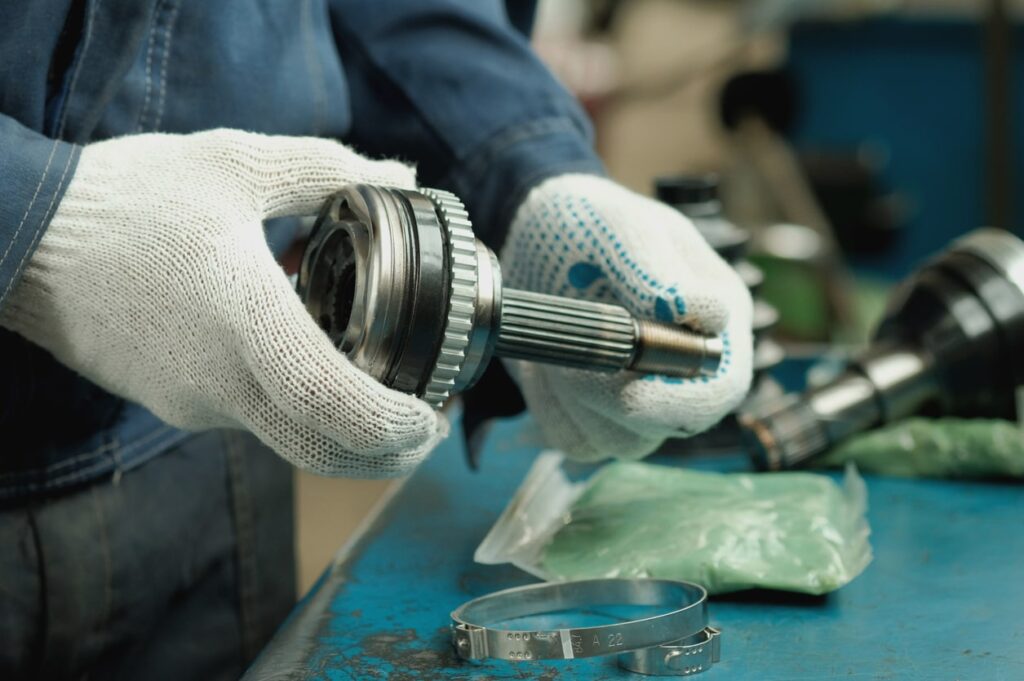
Driveshafts rely heavily on lubrication to keep their joints moving smoothly. The constant velocity (CV) joints, in particular, require grease to prevent friction and overheating. These joints are protected by rubber boots, often referred to as CV boots, which are designed to keep the grease in and dirt out.
When these boots crack or split, which can easily happen over time, the grease escapes and contaminants like water, grit, and road salt make their way in. This is a common issue we see with Audi Q5 and Q7 models, particularly during the winter months when road salt is used extensively in the UK. Without proper lubrication, the joints wear down quickly, leading to clicking noises when turning and, eventually, complete failure of the driveshaft.
Exposure to Road Conditions
The UK’s roads play a big part in driveshaft longevity. Harsh winters, wet conditions, and road salt all contribute to premature driveshaft wear. Even in newer models like the Audi A3 or Audi A6, regular exposure to salt and grit can corrode the metal surfaces and damage protective boots.
Drivers who regularly travel on rural or coastal roads may see more rapid deterioration than those who stick to motorways. Corrosion not only weakens the driveshaft but also affects the balancing of the shaft, which can cause vibrations and instability at higher speeds.
Overloading and Driving Habits
Driveshafts are designed to handle specific amounts of torque and load. When vehicles are consistently overloaded, the driveshaft is put under excessive strain. This is especially relevant to SUVs such as the Audi Q7, which may be used for towing caravans or trailers.
Aggressive driving habits can also contribute to driveshaft failure. Rapid acceleration, sharp cornering, and hard braking all increase the stress placed on the shaft and its joints. For performance models like the Audi TT or S5, spirited driving is expected, but it also means the driveshaft experiences much higher levels of torque than in a standard hatchback like the Audi A3. Without regular maintenance, this added stress can quickly lead to failure.
Misalignment and Poor Installation
Another cause of driveshaft failure is improper installation or misalignment. A driveshaft must be precisely balanced and correctly positioned in order to function effectively. If it is even slightly out of alignment, it can cause vibrations, uneven wear, and premature failure.
We occasionally see this issue in customers who have had driveshafts replaced with cheap aftermarket parts or fitted without proper expertise. In vehicles with advanced drivetrain systems such as the Audi A6 quattro or Audi Q5, precision is even more critical. A poorly installed driveshaft can lead to problems not only with the shaft itself but also with the differential and gearbox.
Accidents and Physical Damage
Physical damage is another common reason for driveshaft problems. Hitting a deep pothole, driving over a kerb, or being involved in an accident can bend or crack the driveshaft. Even small amounts of damage can throw the shaft out of balance, leading to vibrations that get worse over time.
We often see this in city-based Audi A3 or A4 drivers, where urban roads are full of hazards like potholes and speed bumps. Once the shaft is damaged, it rarely recovers and usually requires replacement. Attempting to drive on a bent driveshaft not only feels uncomfortable but also risks further damage to surrounding components.
Signs That Your Driveshaft Is Failing
Understanding the signs of a failing driveshaft can help you take action before it completely gives out. Vibrations through the steering wheel or floor are often the first indication. These vibrations typically worsen as you accelerate and can make long drives very uncomfortable.
Another sign is unusual noises. Clicking, clunking, or knocking sounds when turning or shifting gears are often linked to worn CV joints. If you own an Audi Q5 or Q7, you may also notice shuddering when pulling away from a stop, which is a clear indicator of driveshaft issues. For smaller models like the Audi A4 or A5, you might notice more subtle symptoms such as reduced smoothness when cornering.
Any of these signs should prompt you to seek a professional inspection as soon as possible.
Preventing Driveshaft Failure
While some degree of wear is unavoidable, there are steps drivers can take to extend the life of their driveshaft. Regular servicing is the most effective way to catch issues early. During routine checks, mechanics can spot cracked CV boots, worn joints, or signs of imbalance before they turn into major problems.
For Audi owners, sticking to the manufacturer’s recommended service schedule is crucial. The Audi A6 and Q7, for instance, require regular inspections of their quattro systems, which include driveshaft checks. Avoiding overloading, driving carefully over rough roads, and keeping an eye on road salt exposure will all help protect your driveshaft.
Choosing quality replacement parts is also key. At Driveshaft UK, we only supply driveshafts that are engineered to meet or exceed OEM standards, ensuring that your Audi continues to perform exactly as it should.
Why Choose Driveshaft UK?
As a UK-based specialist, we understand the challenges drivers face on British roads. Our team has extensive experience with Audi models ranging from the compact A3 to the larger Q7, and we know exactly what to look out for when diagnosing driveshaft problems.
We don’t just sell driveshafts—we provide complete solutions. Whether you need advice on selecting the correct part for your Audi A4, support with installation on an Audi Q5, or guidance on maintenance for an Audi TT, our experts are here to help. We take pride in offering high-quality components, expert knowledge, and reliable service that drivers can trust.
Conclusion
Driveshaft failure can be caused by many different factors, from natural wear and tear to lack of lubrication, exposure to harsh road conditions, or physical damage. The way you drive and maintain your car plays a significant role in how long your driveshaft lasts. By understanding the causes of failure and the warning signs to watch out for, you can protect your Audi and keep it running at its best.
At Driveshaft UK, we specialise in providing tailor-made driveshaft solutions for a wide range of Audi models, including the A3, A4, Q5, and Q7. If you suspect your driveshaft may be failing, or if you simply want expert advice on maintaining your vehicle, our team is here to help. With the right care and the right parts, you can enjoy smooth, safe, and reliable driving for years to come.
If you’d like more advice on your driveshaft, think yours might need replacing, or just want to talk to a real expert, contact Driveshaft UK today. We’re here to help keep your car smooth, stable, and ready for every mile ahead.