
What Does a Half Shaft Do in a Car?
Oct 9, 2025
At Driveshaft UK, we spend a lot of time helping drivers understand how their vehicle’s drivetrain works, because when you understand how the parts work together, you can better maintain performance, reliability, and safety. One component that often goes unnoticed, yet plays a vital role in how your car moves, is the half shaft.
You might have heard it mentioned by your mechanic or seen it listed on a repair invoice, but what exactly does a half shaft or driveshaft do? How does it affect your car’s performance? And what happens if it fails? In this guide, we’ll take a closer look at the mechanics, function, and importance of the half shaft in modern vehicles, along with some real-world examples relevant to UK drivers.
Understanding the Half Shaft
The half shaft is one of the key components of a vehicle’s drivetrain — the system responsible for transferring power from the engine to the wheels. In simple terms, it is a rotating shaft that connects the differential, which splits power between the wheels, to the wheel hub itself. This allows torque from the engine to reach the wheels, propelling the car forward or backward.
Each driven wheel on a vehicle typically has its own half shaft. In a front-wheel-drive car, there are two half shafts connecting the transaxle to the front wheels. In rear-wheel-drive vehicles, they are located at the back, transferring power from the rear differential to each wheel. In all-wheel-drive and four-wheel-drive systems, there are half shafts at both the front and rear.
Without half shafts, the car would not move at all, as there would be no physical connection between the engine and the wheels. They are, quite literally, the link that turns engine power into motion.
How the Half Shaft Works
To understand the half shaft’s role, it’s helpful to look at how power flows through a car. When you press the accelerator, the engine produces torque. This torque is transmitted through the gearbox, or transmission, to the differential, which splits the power between the drive wheels. The half shafts are responsible for carrying that power from the differential to each individual wheel.
However, unlike a solid, fixed axle, the half shaft must also accommodate movement. As the wheels rise and fall with the suspension, the angle between the differential and wheel hub changes constantly. This is where the half shaft’s flexibility, provided by its constant velocity (CV) joints, comes into play. These joints allow the shaft to maintain smooth power delivery even as the suspension moves or the wheels turn.
In everyday driving, the half shaft is under continuous load, transmitting high levels of rotational force while coping with varying road conditions, speeds, and directional changes.
The Importance of Constant Velocity Joints
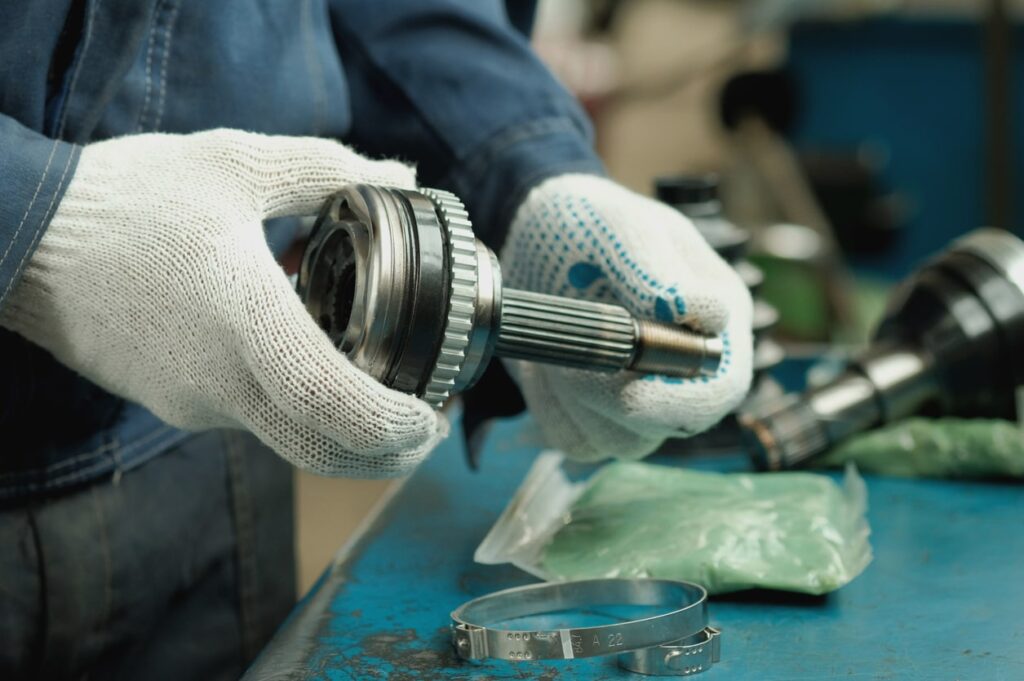
Each end of a half shaft contains a CV joint, one at the inner end connecting to the differential and one at the outer end connecting to the wheel hub. These joints are crucial to the half shaft’s operation. They enable smooth power transfer by compensating for changes in angle and length as the suspension moves.
Without CV joints, your vehicle would experience jerky, uneven movement and severe drivetrain stress every time you hit a bump or turned the wheel. The CV joints are protected by rubber boots filled with grease, which keeps the joint lubricated and free from contaminants like water, grit, and salt.
If a CV boot becomes damaged, grease can leak out, and dirt can enter the joint. This quickly leads to wear and, eventually, joint failure. Many cases of half shaft failure begin with neglected CV joint maintenance — one reason why regular inspections are so important.
The Role of the Half Shaft in Vehicle Handling
While the half shaft’s main purpose is to transfer power, it also has a major influence on how a car handles. In front-wheel-drive vehicles, the half shafts help to stabilise the power delivery between both front wheels, reducing torque steer, the pulling effect that happens under hard acceleration.
In rear-wheel-drive and all-wheel-drive vehicles, the half shafts are essential for maintaining traction. They ensure that both driven wheels receive equal torque, which is critical when cornering, accelerating, or driving on slippery surfaces.
If a half shaft is damaged, bent, or imbalanced, the driver might notice vibrations through the steering wheel or floor, especially under acceleration. These vibrations are more than an annoyance — they can affect handling stability and lead to further mechanical wear elsewhere in the drivetrain.
What Happens When a Half Shaft Fails
A damaged or failing half shaft can cause a variety of symptoms, depending on the extent of the problem. The most common warning signs include vibrations during acceleration, clunking or clicking noises when turning, and loss of power to one wheel. In severe cases, complete half shaft failure can result in total loss of drive.
One of the first things that often fails is the CV joint, usually due to lack of lubrication or contamination. As the joint deteriorates, it can produce a rhythmic clicking sound, especially when turning. If the shaft itself becomes bent or imbalanced, perhaps due to hitting a pothole or kerb, vibrations and shaking will occur.
If ignored, a damaged half shaft can cause further issues by straining other drivetrain components such as the gearbox, differential, and bearings. This can turn a simple repair into a far more expensive problem.
Common Causes of Half Shaft Damage
Half shaft wear is inevitable over time, but certain conditions accelerate it. UK drivers face several challenges that can contribute to premature wear, including potholes, uneven road surfaces, and exposure to water and salt during winter. These conditions can damage CV boots, corrode metal surfaces, and throw the shaft out of balance.
Vehicles that carry heavy loads, such as vans and pickups, also experience greater strain on their half shafts. A Mercedes half shaft, for example, must endure high torque and heavy payloads, particularly in models like the Mercedes Sprinter. Similarly, Ford Transit and Volkswagen Transporter vans face similar demands.
Performance cars and modified vehicles can also wear out their half shafts faster due to increased power output. In these cases, upgrading to heavy-duty or reinforced shafts can significantly improve reliability and lifespan.
Maintenance Tips for Half Shafts
Caring for your half shafts doesn’t require complex maintenance, but regular inspections make a huge difference. During routine servicing, mechanics should check the CV boots for cracks, tears, or grease leaks. If caught early, a damaged boot can be replaced inexpensively, preventing costly CV joint or half shaft damage later.
Drivers should also pay attention to any unusual vibrations, noises, or changes in handling. These are early indicators that something may be wrong with the drivetrain. Keeping the underside of your vehicle clean, especially after driving on salted winter roads, can also help prevent corrosion.
At Driveshaft UK, we often remind customers that preventative maintenance is always more cost-effective than reactive repair. A well-maintained half shaft can last many years, even in demanding conditions.
Replacing a Half Shaft
When replacement is necessary, it’s essential to choose a high-quality part designed for your specific vehicle. Not all half shafts are the same — their length, joint design, and spline count vary between models. A poorly fitted or inferior-quality half shaft can lead to noise, vibration, or early failure.
At Driveshaft UK, we supply precision-engineered half shafts for a wide range of vehicles, from everyday cars to commercial vans and performance models. Every half shaft we provide is manufactured to meet or exceed OEM standards, ensuring perfect fitment, strength, and balance. Whether you need a replacement for a Ford Transit, Mercedes Sprinter, or BMW 3 Series, we offer parts built for durability and long-term reliability.
Professional installation is also key. A correctly aligned and balanced half shaft guarantees smooth operation and prevents unnecessary wear to other drivetrain components.
How Upgraded Half Shafts Improve Performance
For drivers who demand more from their vehicles, whether that means faster acceleration, greater towing capacity, or improved off-road ability, upgrading to high-performance half shafts can make a real difference.
Upgraded shafts are often made from higher-grade steel or lightweight alloys that resist twisting and bending under stress. They also feature enhanced CV joints designed to handle higher torque and rotational speeds. For example, van drivers who regularly carry heavy loads or car enthusiasts who have tuned their engines will benefit from stronger, reinforced shafts that can handle the added power.
Upgrading isn’t just about strength; it can also improve the driving experience. A smoother, more responsive drivetrain enhances acceleration, reduces vibration, and adds to the overall sense of refinement.
The Half Shaft’s Role in Modern Automotive Engineering
As vehicle technology advances, so too does the engineering behind half shafts. Modern shafts are lighter, stronger, and more efficient than ever before. Computer-aided design and precision machining allow manufacturers to achieve incredibly tight tolerances, improving balance and reducing vibration.
Electric and hybrid vehicles have also changed the landscape. These cars deliver instant torque from electric motors, placing even greater demands on half shafts. As a result, manufacturers are developing new materials and designs that can handle the high torque loads of electric drivetrains while maintaining smooth operation and efficiency.
At Driveshaft UK, we stay up to date with these developments, ensuring our products meet the latest engineering standards and are ready for the next generation of vehicles.
The Future of Half Shaft Design
Looking ahead, the future of half shaft design will likely focus on lighter materials, improved lubrication systems, and enhanced resistance to wear and corrosion. Composite materials like carbon fibre are already being tested in performance vehicles, offering exceptional strength-to-weight ratios.
Manufacturers are also exploring sealed-for-life CV joints that require less maintenance and can endure extreme operating conditions. This means fewer replacements and longer-lasting reliability for drivers.
For UK motorists, these advances will result in smoother, more efficient cars and vans that require less frequent drivetrain servicing while still maintaining the strength needed for the demands of British roads.
Conclusion
The half shaft may not be the most talked-about part of a car, but it is one of the most important. It is the crucial link that transforms engine power into wheel movement, enabling every journey you take. Whether you drive a small hatchback, a family SUV, or a hard-working commercial van, your half shafts are constantly at work transferring power, maintaining traction, and ensuring a smooth ride.
Understanding what a half shaft does, recognising the signs of wear, and maintaining it properly can save you from costly repairs and breakdowns. And if replacement or upgrading becomes necessary, choosing high-quality, precision-engineered components makes all the difference.
At Driveshaft UK, we supply and support drivers across the country with top-quality half shafts built for strength, balance, and reliability. From everyday vehicles to high-performance and commercial applications, we ensure every driver enjoys smoother, safer, and more efficient driving powered by engineering you can trust. Contact us today.