
How Many Driveshafts Does a Car Have?
Jul 9, 2025
When it comes to how your car actually puts power to the road, few people stop to think about the humble driveshaft. Yet, it’s one of the most vital components of your vehicle’s drivetrain. Understanding how many driveshafts your car has and what they do is more than just trivia — it helps you spot problems early and make informed decisions when something needs replacing. At Driveshaft UK, we’ve spent decades supplying high-quality driveshafts for all makes and models, including being the go-to specialist for VW Passat driveshafts across the UK. So, whether you’re a curious car owner or just want to be better prepared next time you visit your mechanic, here’s everything you need to know about driveshafts and how many your car might have.
What Exactly Does a Driveshaft Do?
Before we get into the numbers, it’s important to understand what a driveshaft actually does in your car. In simple terms, a driveshaft transfers power from your vehicle’s gearbox to the wheels. In a front-wheel-drive car like many VW Passats, this power needs to go from the transaxle (which combines the gearbox and differential) directly to the front wheels. In a rear-wheel-drive car, the driveshaft transfers power from the gearbox, usually located towards the front, to the rear differential, which then sends it on to the rear wheels.
All-wheel-drive and four-wheel-drive systems add another layer of complexity. These setups often use a prop shaft — sometimes called a propshaft or propeller shaft — to deliver power to the rear wheels while the front wheels are driven by shorter driveshafts, also known as half shafts. So, depending on your vehicle’s drivetrain layout, the number of driveshafts can vary quite a bit. This is one reason why we at Driveshaft UK carry such an extensive range, covering everything from simple single-shaft setups to complex AWD systems.
Front-Wheel Drive: How Many Driveshafts Are There?
The most common layout on the roads today is the front-wheel-drive configuration. Cars like the VW Passat, Ford Focus, and Vauxhall Astra all have front-wheel drive in their more standard trims. In these cars, the engine is mounted transversely, meaning it sits sideways in the engine bay, and the gearbox sits right next to it. This means the distance between the gearbox and each front wheel is quite short.
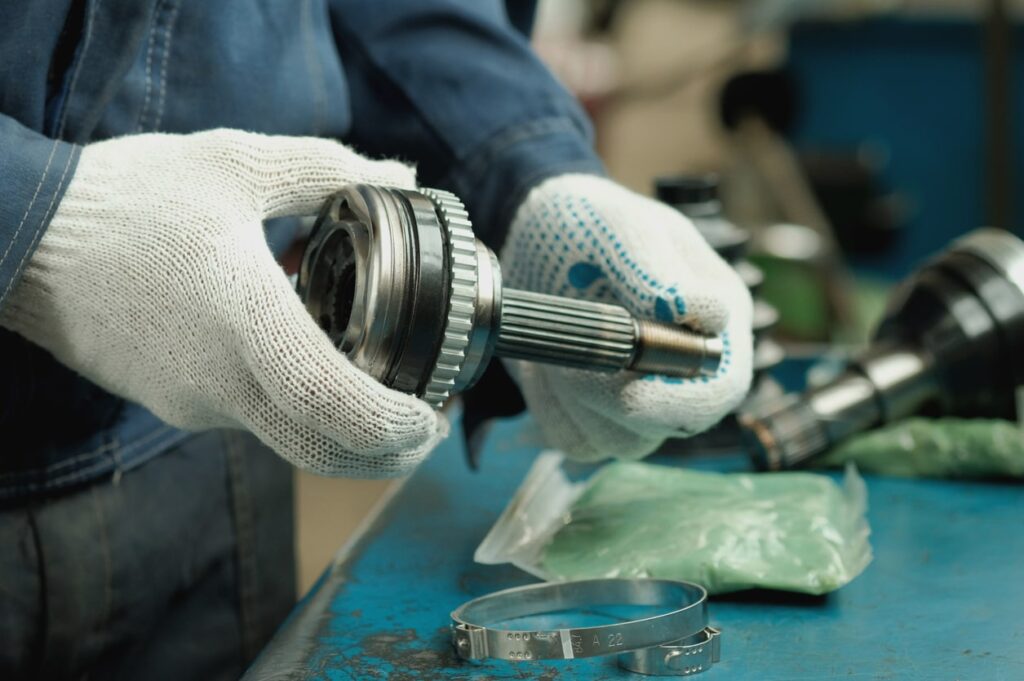
In a front-wheel-drive car, there are typically two driveshafts — one for each front wheel. These are often called half shafts because they’re shorter than a traditional rear driveshaft. Each shaft is connected to the gearbox by constant velocity joints, better known as CV joints, which allow the wheels to turn left and right and move up and down with the suspension while still being driven smoothly. CV joints are packed with grease and protected by rubber boots. If those boots split, the joints can fail over time. At Driveshaft UK, we specialise in supplying these exact replacement shafts for VW Passats and countless other makes, ensuring they match the original factory fit.
Rear-Wheel Drive: What Changes?
Things work a little differently with rear-wheel-drive cars. In a typical rear-wheel-drive setup, the engine sits lengthways under the bonnet, and the gearbox is directly connected to a long driveshaft that runs underneath the car to the rear axle. This is known as the prop shaft or propeller shaft. Its job is to bridge the gap between the gearbox and the rear differential.
A classic example of a rear-wheel-drive car might be an older BMW 3 Series, a Mercedes-Benz saloon, or some performance versions of the VW Passat, like the Passat CC with specific drivetrain options. In these cases, you’ll find one long driveshaft rather than two short ones at the front. From the rear differential, two smaller half shafts then connect to each rear wheel. So, technically, a rear-wheel-drive car could have up to three driveshafts: one prop shaft and two half shafts.
This is why it’s always worth knowing your vehicle’s drivetrain before ordering parts. At Driveshaft UK, we stock a huge range of prop shafts and rear half shafts, and our experienced team can help you identify exactly what your specific model needs. A rear-wheel-drive car might seem simpler because you only have to worry about the rear wheels doing the driving, but the long prop shaft means there are different wear points to look out for, such as centre bearings and universal joints.
All-Wheel Drive: A Combination of Both
Modern all-wheel-drive and four-wheel-drive cars combine elements of both systems, making things even more interesting when you ask, “How many driveshafts does this car have?” In an AWD Passat, for instance, the front wheels are driven by the standard front half shafts, just like a regular front-wheel-drive version. But in addition, there’s a transfer case that sends power to a prop shaft, which runs to the rear differential, powering the rear wheels too.
This means an AWD Passat typically has at least four driveshafts — two front half shafts and two rear half shafts, with a prop shaft linking the gearbox to the rear. Some 4x4s and SUVs have even more complex setups with multiple differentials and centre drive shafts with variable lengths, depending on suspension travel and off-road capabilities.
This added complexity means there’s more to check when you experience vibrations, clunking noises, or other signs of driveshaft wear. At Driveshaft UK, we pride ourselves on being one of the UK’s leading suppliers of driveshafts for all-wheel-drive vehicles, not just for the VW Passat but for every major brand. Whether you need a front half shaft or a full-length prop shaft, we have the parts ready to get your car back on the road quickly and safely.
Signs Your Driveshaft Needs Attention
No matter how many driveshafts your car has, it’s important to keep an ear out for signs that something isn’t quite right. Vibrations felt through the steering wheel or the floor at higher speeds often point to a driveshaft issue, especially if the wheels and tyres have already been balanced. Clicking or knocking noises when turning corners, especially in front-wheel-drive cars, can be an early sign that a CV joint is worn out.
In rear-wheel-drive and AWD setups, you might notice clunking when changing from drive to reverse or when accelerating hard, which can indicate worn universal joints or centre bearings. Another giveaway is seeing grease around your wheels, as this often means the CV boot has split, leaving the joint exposed to dirt and water. Ignoring these signs can lead to complete driveshaft failure, which could leave you stranded or cause further damage to your gearbox or differential.
At Driveshaft UK, we always advise getting any suspicious noises checked as soon as possible. Our team can help you identify whether you need a simple CV boot replacement or a complete driveshaft. We know that every car is different, so we take the time to match you with the right solution every time.
Why Driveshaft UK is the Trusted Choice for VW Passat Driveshafts and More
For drivers up and down the country, Driveshaft UK has become the trusted name for reliable driveshafts. We have years of experience supplying new and remanufactured driveshafts for the VW Passat — one of the UK’s most popular family cars — and all other makes and models too. From front-wheel-drive hatchbacks to powerful AWD SUVs, we keep the right parts in stock so you don’t have to wait weeks to get back on the road.
All our driveshafts are either brand-new or carefully remanufactured to meet or exceed original equipment standards. We know that quality matters when you’re dealing with a part that sits at the heart of your car’s performance and safety. Every driveshaft we sell is checked and balanced by skilled UK technicians who understand how vital precision is for a smooth, safe drive.
When you choose Driveshaft UK, you’re not just buying a part. You’re getting honest advice, fast delivery, and the reassurance that you’re dealing with a company that cares about your car as much as you do. Whether you need a single front half shaft for your everyday runaround or a complex prop shaft assembly for your all-wheel-drive estate, we’re here to help every step of the way.
Looking After Your Driveshafts for the Long Run
Once you know how many driveshafts your car has, it makes sense to look after them properly. Regular inspections can help catch problems early before they become more serious. Keeping an eye on the condition of your CV boots is particularly important for front-wheel-drive and AWD vehicles because a split boot can let dirt in and destroy a CV joint over time. It’s also a good idea to get your wheels balanced and aligned regularly, as misalignment can put extra stress on your driveshafts and CV joints.
If you’re not sure whether your car is front-wheel drive, rear-wheel drive, or all-wheel drive, don’t worry — you’re not alone. Many owners only find out when they experience a vibration or noise and need to figure out what’s going on underneath the car. That’s where Driveshaft UK comes in. We’re always happy to chat, help you identify your setup, and recommend the best course of action, whether that’s a replacement, refurbishment, or simple maintenance advice.
Final Thoughts: More Than Just a Number
So, how many driveshafts does a car have? The honest answer is that it depends entirely on your car’s design. Most front-wheel-drive cars have two, rear-wheel-drive cars can have one long prop shaft plus two rear half shafts, and all-wheel-drive cars can have even more. The important thing is not just the number but knowing what signs to watch out for and where to go when you need a replacement.
At Driveshaft UK, we’ve built our reputation on supplying top-quality driveshafts for the VW Passat and countless other makes and models across the UK. We believe that every driver should feel confident that the parts under their car are reliable, safe, and built to last. When you buy from us, you’re not just getting a part — you’re getting our expertise and our commitment to keeping you and your family safe on the road.
If you’d like more advice on your driveshaft, think yours might need replacing, or just want to talk to a real expert, contact Driveshaft UK today. We’re here to help keep your car smooth, stable, and ready for every mile ahead.